
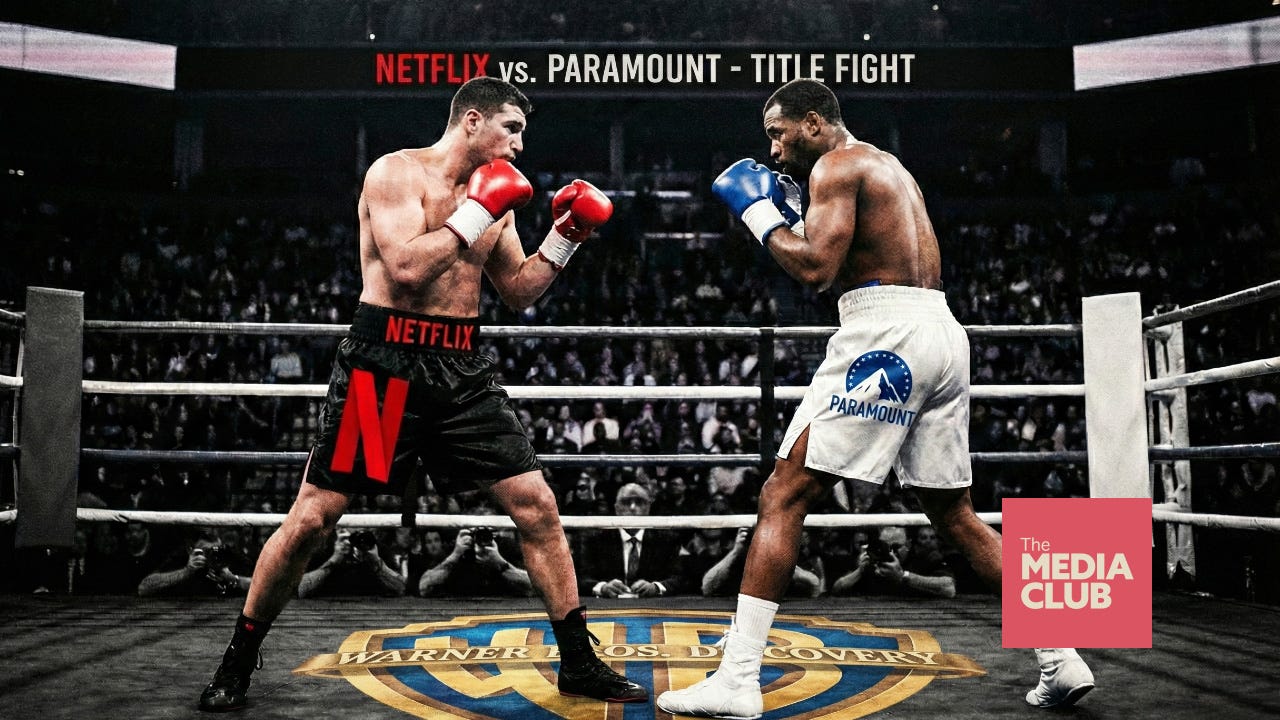
We’ve had a week where the streaming wars reached fever pitch as Paramount launched a hostile counter-bid for Warner Bros Discovery, potentially forcing Netflix into a bidding battle that could reshape Hollywood forever. The media world watched transfixed as billion-dollar deals collided with regulatory concerns, whilst Channel 4 appointed Priya Dogra as its new chief executive and Eurovision faced its biggest crisis in decades over Israel’s participation. Meanwhile, investigative journalism came under fresh scrutiny as legal threats mounted, the BBC’s future sparked debate through a major British Academy report, and Australia’s social media ban finally kicked in amid fierce opposition. Christmas advertising dominated creative discussions, whilst media mergers continued their relentless march across the industry landscape.
If you missed Friday’s The Media Club, I examined the biggest media deal in a decade as Netflix’s Warner Bros acquisition faced that Paramount counter-bid, exploring how this seismic week affects consumers and cinema-goers, hearing from indie MD Faraz Osman about the implications. We also discussed filmmaker Mike Christie’s new Nick Cave documentary and how Red Bull’s space jump transformed branded content, plus Disney’s OpenAI investment and Eurovision’s impending implosion. Listen
The Media Show (10th December)
Katie Razzall and Ros Atkins examined Hollywood’s turmoil as Netflix’s $72bn Warner Bros Discovery deal faced Paramount’s rival bid. They spoke with Natalie Jarvey from The Ankler and Dade Hayes from Deadline about the implications for beloved franchises like Harry Potter and Game of Thrones, alongside author Charlotte Henry discussing streaming’s future. Eurovision dominated another segment as the contest faces its biggest crisis in years, with countries pulling out over Israel’s participation and broadcasters debating whether to air it at all. BBC Music Reporter Mark Savage provided the latest on the unfolding controversy. The programme also featured Radio Times Brand Editor Shem Law discussing the Christmas edition’s fight to remain relevant in the streaming era, plus Alex Hern from The Economist on Meta’s shift from metaverse ambitions to artificial intelligence investment.
Media Confidential (8th & 11th December)
Alan Rusbridger and Lionel Barber hosted Franz Wild, editor-in-chief and CEO of the Bureau of Investigative Journalism, for a discussion about society’s dire need for investigative reporting and the particular character traits needed to pursue stories that might take years to develop. They explored funding models, the menacing letters Bureau editors receive, and why they refuse to be intimidated by legal threats against their journalists. In his final episode as Prospect editor, Alan reflected on his time at the magazine and compared it to his Guardian years. The pair discussed Netflix’s bid for Warner Bros, the hunt for Channel 4’s new CEO, and the murky world of content moderation.
Roger Bolton’s Beeb Watch (12th December)
Roger Bolton interviewed Professors Georgina Born and Justin Lewis, co-authors of the British Academy report on the future of the BBC and public service media. Their comprehensive study examined evidence from the UK to Scandinavia, Canada to Australia, presenting findings about what works and what doesn’t. They discussed the importance of democratic governance, the licence fee’s decline, and the urgent need for independent funding mechanisms. The conversation explored public service media’s role, threats from global big tech, governance and political independence, licence fee alternatives, the idea of a permanent charter, strategies for engaging young audiences, and developing new approaches to public service media in the digital age.
Insiders: The TV Podcast (12th December)
Peter Fincham and Jimmy Mulville discussed Channel 4’s appointment of Priya Dogra as new Chief Executive, examining how her commercial background will help navigate the channel’s challenges whilst questioning her editorial vision approach. They analysed the latest twists in the Netflix/Paramount bidding war for Warners and gave themselves an early Christmas gift by watching Meghan Markle’s “With Love, Meghan” Christmas special on Netflix and The Liz Truss Show on YouTube, finding surprising commonalities between the two programmes.
TellyCast (11th December)
Sam Barcroft returned with major news as the new Group CEO of SWNS Media, the UK’s largest independent newswire. He explained how news, social video and the creator economy are colliding faster than expected and what this means for producers, brands and the entire media landscape. Barcroft broke down the future of news in a video-first world, how SWNS is reshaping itself across six companies, and why trust, truth and journalistic rigour remain paramount despite the rapid transformation.
The Rest Is Entertainment (9th & 11th December)
Richard Osman and Marina Hyde delivered a special episode focused solely on Netflix’s $72bn Warner Bros purchase, explaining why the deal represents the biggest in Hollywood history and examining whether Trump will approve it. They questioned if this marks the end of cinema for good and revealed why Marina was the only person to correctly predict the deal. Richard and Marina also answered questions about toy companies preparing sets before films are released, Tom Daly’s “Game of Wool” alternative titles, and why Apple TV’s ‘The Hunt’ was pulled from streaming, covering bad puns, plagiarism, and Lego sets.
The Media Odyssey (11th December)
Evan Shapiro and Marion Ranchet delivered their special “Predictions Wrapped” episode, grading their 2025 forecasts for accuracy. They celebrated correctly predicting YouTube’s explosive rise on CTV, Netflix’s unexpected innovation, and creator-driven cultural dominance, whilst acknowledging misses around CTV fragmentation’s slower pace. The conversation revealed the biggest forces shaping 2026: global broadcaster collaboration, a reshaped M&A landscape, a creator economy that’s become central to mainstream media, and an AI boom that’s simultaneously overhyped and quietly transformative behind the scenes.
The Radio Academy Podcast (10th December)
Broadcaster Anoushka Mutanda Dougherty discussed successfully mixing podcasting with daily reporting through her shows “Diddy on Trial” and “Fame Under Fire.” She explained her approach to cutting through showbiz hype to reveal what’s really happening behind celebrity stories, sharing insights about navigating court systems, handling disinformation, and maintaining journalistic standards across traditional and social media platforms.
Campaign Podcast (10th & 11th December)
Campaign’s editorial team examined the new Omnicom following its completed Interpublic acquisition, discussing the massive restructure including 4,000 job cuts, agency mergers, new leadership appointments and entire networks ceasing to exist. Lucy Shelley hosted discussions with Gideon Spanier, Maisie McCabe and Will Green about CEO John Wren’s vision for competing against rivals. In a special Christmas edition, creativity leaders David Kolbusz from Orchard, Chaka Sobhani from TBWA Worldwide, Richard Brim from Ace of Hearts alongside Maisie McCabe reviewed festive campaigns from John Lewis, Waitrose, Tesco, Asda, Apple and Peta, analysing the craft, creativity and ideas behind each advertisement.
TV Show & Tell (8th December)
Justin and David spoke with format development guru Ben Justice, who’s been involved with shows including ‘All Together Now’, ‘Richard Osman’s House of Games’ and ‘Bridge of Lies’. In an innovative move, Justice recently uploaded ‘The Loop’ on YouTube as a shop window for his own format. The hosts discussed the evolving relationship between YouTube and traditional television, examined how niche streaming service Dropout.tv is “changing the game,” and included a postscript about TV industry awards.
TV Makers (9th December)
Andy Mundy-Castle, founder of Doc Hearts and director of BAFTA-winning ‘White Nanny, Black Child’, joined the show to unpack the real craft of documentary storytelling and what it genuinely takes to run a purpose-led independent in one of the toughest TV markets ever seen. Mundy-Castle shared how his background and lived experience shaped his filmmaking approach: stories rooted in truth, crafted with cinematic ambition, and always led by empathy over exploitation.
The Media Leader Podcast (8th & 11th December)
Jack Benjamin interviewed The Guardian’s Imogen Fox about their “Shift Happens” research project, examining five major changes in how consumers spend their time throughout the week, including waking up earlier, maximising weekends, early Friday pub visits, and work-life balance reassessment. In a second episode produced in partnership with Roku, Benjamin spoke with Mike Shaw, director of EMEA ad sales, about the company’s commercial strategy, its position within the CTV ecosystem, retail media partnerships, measurement innovations, and how the TV market is becoming more data-led and programmatic.
The Publisher Podcast by Media Voices (8th December)
Peter Houston and Esther Kezia Thorpe delivered their end-of-year episode, highlighting favourite interviews including chats with DC Thomson’s Rebecca Miskin and Immediate Media’s Sean Cornwell about managing disruption and transformation, plus Liesbeth Nizet from Mediahuis on engaging younger audiences. They shared their outlook for 2026, predicting the industry will face further challenges before improvement, whilst examining why younger audiences pay for games and entertainment but remain reluctant to fund news.
The Future of Media, Explained (11th December)
Dominic Ponsford spoke with WP Engine director of product management Jason Konen and Bigbite CTO Jason Agnew about the future of content management. Both WordPress experts discussed how publishers are responding to falling referral traffic by making websites more immersive and community-focused. They examined AI’s role in streamlining content production and removing complexity from journalists’ workflows, debating the importance of ensuring content visibility in platforms like ChatGPT.
MediaLand (12th December)
Tim Burrowes and Vivienne Kelly delivered their final episode, looking back at the year’s major media stories and their implications for 2026 content. They covered massive media mergers, succession changes in major media families, and whether commercial radio can still afford multiple hosts per show. Producer Rob Kelly joined as a guest to discuss the industry’s transformation, from consolidation mania to Australia’s social media ban implementation and its real-world impacts on families and media consumption.
Podnews Weekly Review (12th December)
James Cridland and Sam Sethi tracked the biggest forces shaping podcasting’s future, examining Goalhanger’s network effect, the pivot to listener-based analytics, and tension between open RSS and closed “podcast” branding from major platforms. They discussed video hosting defaults, live streaming developments, and why honest metrics will determine winners. The hosts analysed Apple’s Show of the Year milestone achievements and explored how cross-promotion and cadence function as scalable growth levers.
When It Hits the Fan (10th December)
David Yelland and Simon Lewis examined Simon Cowell’s latest PR campaign piecing together publicity around his newest show to understand his attempts at staying relevant whilst offering unintended glimpses into his world. They analysed whether showing a different side benefits the music mogul’s brand, examining how he’s managed his Bad Guy persona across decades whilst adapting to changing media landscapes and audience expectations.
On the Media (10th & 13th December)
Brooke Gladstone and Micah Loewinger examined a contentious legal battle featuring celebrity gossip blogger Perez Hilton, exploring journalism’s evolving boundaries and First Amendment protections in the social media age. They questioned what constitutes journalism when traditional and new media intersect, particularly around celebrity coverage and legal subpoenas. In their main episode, they covered Trump’s targeting of the FTC, Supreme Court debates on presidential power, and Hollywood’s existential crisis as the Paramount v Netflix battle intensifies, questioning whether audiences ultimately lose regardless of the outcome.
Mixed Signals from Semafor Media (12th December)
Ben Smith and Max Tani interviewed comedy veteran Andy Richter, Conan O’Brien’s longtime sidekick, for an existentially funny conversation about surviving three decades in entertainment. Richter discussed becoming late night’s most adaptable performer, whether he worried about becoming “the next Ed McMahon,” why acting work has become elusive in Hollywood, late night’s decline as a cultural force, and how “Dancing With the Stars” accidentally turned him into a TikTok phenomenon.
Channels with Peter Kafka (10th December)
Peter Kafka interviewed Lachlan Cartwright, who runs the must-read Breaker newsletter and podcast covering New York media gossip. Cartwright, an Australian who started at Rupert Murdoch’s tabloids before moving to the National Enquirer during its Trump catch-and-kill era, discussed how tabloid training shaped his reporting approach, his Enquirer experiences, and why he believes there’s still business appetite for smart, deeply-inside media gossip in an oversaturated market.
The Grill Room (9th & 12th December)
Dylan Byers and Julia Alexander interviewed Yahoo CEO Jim Lanzone about the company’s transformation four years after private equity giant Apollo bought it for $5 billion—$120 billion below its peak valuation. Lanzone explained Yahoo’s growth strategy, meaningful metrics, scale monetisation, and endgame vision, plus AI ambitions and running a mass-market consumer business in a media landscape increasingly focused on niche content. They also examined Disney’s OpenAI deal pumping 200+ Disney characters into Sora for fan-generated content, analysing the WBD bidding war between Paramount and Netflix, regulatory challenges, and each company’s contingency plans.
The Town with Matthew Belloni (9th & 11th December)
Matt Belloni interviewed Peter Supino from Wolfe Research to discuss Paramount’s hostile takeover bid for Warner Bros, just days after Netflix agreed to their deal. Supino mapped out the differences in each bid and made cases for and against each bidder, covering the latest comments from David Ellison, Ted Sarandos, and Donald Trump, plus where Paramount-Skydance’s financing originates. Belloni also spoke with casting director Tiffany Little Canfield about casting major franchise roles that draw thousands of auditions, using ‘Wicked’ as an example, discussing the challenges of casting stars versus unknowns, misconceptions about the casting process, and Hollywood’s lack of young movie stars.
The Ankler Podcast (11th & 14th December)
Elaine Low, Sean McNulty and Natalie Jarvey analysed Warner Bros’ 10-day window to respond to Paramount’s hostile counteroffer, examining Jared Kushner and Middle East money backing the new bid. They discussed industry and union efforts to fight the merger, public sentiment’s role, and the business chill likely until resolution. Katey Rich reviewed the Golden Globe nominations, identifying snubs and surprises, plus how a combined HBO-Netflix would dominate awards season. In a bonus episode, Natalie interviewed creator Noah Beck and Olympic gymnast Jordan Chiles about building fandom and careers beyond their primary fields through social media and new opportunities.
Spot any media podcasts we’ve missed? Reply and let us know! And if you haven’t already, subscribe to The Media Club on your favourite podcast app or catch us on YouTube.