
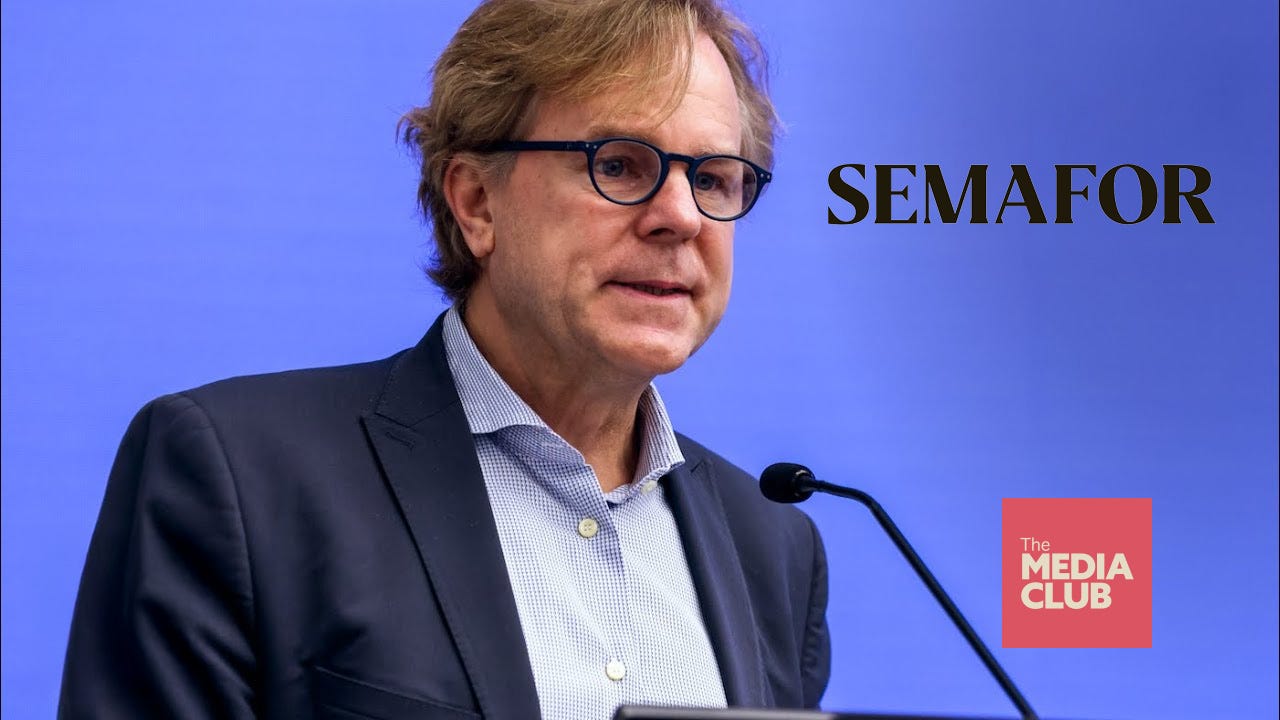
This week the Semafor bosses have been doing the rounds talking about their $30m raise and valuation. There’s been more WBD chat, Prince Harry’s legal challenge of the Daily and Mail as well as general Trump machinations (as always).
If you missed Friday’s The Media Club, my guests were broadcaster Alex Zane and Conrad Withey, Chief Commercial Officer at Goalhanger. Conrad gave us an exclusive - that they had hit 250,000 paying members of their clubs. We also chatted about their business model and how the hosts’ share works too. Watch the full interview below:
The Media Show (14th January)
Katie Razzall and guests explored Elon Musk’s AI chatbot Grok facing investigation under the Online Safety Act for generating non-consensual images, with Ofcom launching a probe and the UK government preparing new laws to ban ‘nudification’ tools. The show featured Chi Onwurah MP and CNN’s Hadas Gold examining what this means for tech regulation. They also discussed how Iran’s recent protests sparked debate about international media coverage, speaking with BBC Persian’s Behrang Tajdin, Lyse Doucet, and Conservative MP Tom Tugendhat about reporting challenges. Plus, Phil Maguire from the Prison Radio Association reflected on building the world’s first national radio station for prisoners, and Liza Marshall, producer of the new film Hamnet, revealed how she secured the rights early before Maggie O’Farrell’s novel became a global sensation.
Media Confidential (15th January)
Lionel Barber dialled in from a cycling trip in South Africa whilst Alan Rusbridger reviewed Liz Truss’s recently launched YouTube channel, which appears rife with conspiracy theories. The pair discussed the rise of social media politics and examined the UK’s stance on online safety as Starmer suggested X could lose the right to self-regulate. They shared concerns about the potential sale of the Telegraph to the Daily Mail group, questioning whether the merger of broadsheet and tabloid values can ever work successfully. The hosts explored the ongoing tussle with tech giants and whether the government should go head-to-head with Elon Musk on platform regulation.
Roger Bolton’s Beeb Watch (14th January)
Roger Bolton welcomed Sir Max Hastings, historian and former editor of the Daily Telegraph and London Evening Standard, for a candid discussion about Donald Trump’s attack on the BBC and the roots of hostility toward the broadcaster. Hastings examined the impact of ongoing financial cuts and what the BBC should prioritise, exploring editorial challenges, leadership dilemmas, and the vital role of the World Service. The conversation covered media coverage of the Middle East and the future of public service journalism, with Hastings offering forthright reflections on where British media must go next. He revealed he’s been prevented from writing about Gaza by several major British newspapers because his views would be unacceptable. (Guests: Sir Max Hastings)
Insiders: The TV Podcast (16th January)
Peter Fincham and Jimmy Mulville examined the potential Banijay–All3Media mega-merger and unpacked why “independent TV” may soon exist in name only. They challenged headline claims that YouTube has overtaken the BBC, interrogating what those numbers really mean and questioning who actually pays for content in a platform-first world. The discussion covered Netflix’s all-cash play for Warner Bros and the fragile future of broadcast news, examining the economics of Sky News and Channel 4 and what happens to impartial journalism when linear television fades. They also provided an update on Trump versus the BBC, with the broadcaster set to stand firm in Florida.
TellyCast (15th January)
Justin Crosby chatted with Steve Ackerman, one of the UK’s leading audio executives and former EVP and Head of Global Podcasts at Sony Music. Ackerman discussed three decades of shaping audio, from starting in hospital radio to building Somethin’ Else into a major content studio before its acquisition by Sony. He explained why audio and video now need to work together, why podcasting is still early in its maturity cycle, how revenue models are evolving, and what traditional TV producers can learn from the creator economy. The conversation covered the new podcast economy and the convergence of traditional and digital content creation.
The Rest Is Entertainment (13th & 15th January)
Richard Osman and Marina Hyde assessed upcoming TV and film releases for 2026, debating which will hit and which will flop in rescuing the box office. They examined Ashley Tisdale’s drama-filled celebrity WhatsApp group controversy and assessed The Traitors at its halfway point, questioning if the show can get any madder with its increasingly unhinged contestants. Their second episode explored the concept of “Heated Rivalry” and why everyone’s talking about it, plus they tackled how screenwriters check they haven’t penned sci-fi faux pas and identified the hardest working actor in Hollywood.
The Media Odyssey (15th January)
Evan Shapiro and Alan Wolk, Co-Founder and Lead Analyst of TVREV, recorded their show from CES to unpack what this year’s show revealed about the future of media beyond the hype of AI demos and hardware announcements. The conversation centred on power shifts: who owns how we get information, who controls discovery, and which companies are positioning themselves as new gatekeepers. Wolk predicted media is entering a prolonged era of “feudal fragmentation” with thousands of disconnected content bubbles, marking the end of monoculture and shared cultural moments. They explored how traditional experts are losing power whilst creator-led studios emerge globally, and why sports remains the last true monoculture.
The Radio Academy Podcast (14th January)
Georgie Jameson presented another in their Meet the Experts series, focusing on Speech Audio. The episode featured Managing Editor of BBC Radio 5 Live Julie Cullen, Programme Director at Times Radio Tim Levell, Commissioning Editor for BBC Radio 4 Julia McKenzie, Head of Radio at RNIB Yvonne Milne, and Global Content Partnerships Director at Acast Sophie Herdman. The experts shared insights and advice on having a lasting career in radio and audio, discussing the evolving landscape of speech content and the skills needed to succeed in the industry. They emphasised the growing importance of video and social media skills alongside traditional audio expertise.
The Media Leader Podcast (12th January)
Justin Lebbon moderated a panel featuring three key brand marketers discussing how they view TV’s strengths compared to other audio-visual platforms. Richard Brooke, global media trading and operations director at Unilever, Sorin Patilinet, global marketing effectiveness lead at PepsiCo, and Alison Keith, formerly head of global marketing effectiveness at Kraft Heinz, explored what brands want from television and where it sits in marketing strategies versus other video platforms. They unpacked whether TV is still “cool,” if YouTube qualifies as TV, and why Unilever increased its spend on social media platforms. The conversation examined ad investment consolidation in Big Tech platforms and whether independent measurement still matters.
The Future of Media, Explained (15th January)
Dominic Ponsford examined Prince Harry’s privacy battle against the Daily Mail in what’s set to be one of Britain’s biggest ever privacy trials, with costs for both sides potentially topping £40 million. Harry has accused the Mail of commissioning burglary, phone tapping, and voicemail interception, whilst the Mail denies everything and accuses Prince Harry’s legal team of using cash payments to witnesses. Ponsford traced back to the News of the World front page in 2008 that started the war on UK tabloids and explained the questionable evidence-gathering tactics the Daily Mail believes undermine Harry’s case. He discussed why Elton John’s backing means this final legal battle is set to go the distance.
Podnews Weekly Review (16th January)
James Cridland and Sam Sethi tackled the year’s early developments, examining iHeartRadio’s addition of OpenRSS video and alternate enclosures alongside Netflix’s exclusivity versus open distribution trade-offs. They discussed Deloitte’s $5 billion forecast and attention data contradictions, plus Spotify’s dynamic video sponsorships and platform fees. The hosts explored Netflix’s deals with companies like iHeart Media for exclusive video partnerships, questioning whether these short-form strategies will succeed where others have failed. Greg Glenday from Acast joined to discuss the platform’s creator-first approach whilst the hosts examined whether twelve months from now, Netflix will abandon this strategy entirely.
When It Hits the Fan (14th January)
David Yelland and Simon Lewis examined how the discussion around weight-loss injections is subtly shifting as new research suggests that once you come off them, you put weight back on faster than traditional methods. The findings dominated news agendas, leading them to question whether the PR worm is turning on these “fat jabs.” They explored what happens when a product leaves ordinary business and becomes something talked about by everyone, emphasising the importance of looking far enough down the track to see potential pitfalls. The extended edition covered how big oil firms are dealing with President Trump and why big tech has much to learn from oil companies’ communications strategies.
Mixed Signals from Semafor Media (15th & 16th January)
Ben Smith and Max Tani produced two episodes this week. First, they interviewed their boss Semafor CEO Justin Smith for a candid discussion about why the digital media company raised $30 million late last year and how it reached profitability in just three years. Justin and Ben reflected on lessons from earlier eras of digital media and the triumphs and mistakes Semafor made, discussing the company’s $330 million valuation and planned investments in the Gulf and East Asia. Their second episode featured Sarah Rogers, the State Department’s undersecretary for public diplomacy, discussing free speech, tech regulation, and her confrontations with European governments over X and the Digital Services Act. Rogers traced her worldview back to early internet culture and Gawker comment sections, explaining why she sees today’s speech rules as potentially dangerous.
Channels with Peter Kafka (14th January)
Peter Kafka interviewed Justin Smith, CEO of Semafor, about how the news startup figured out how to turn a profit in their third year. Smith explained that whilst excellent journalism helps, the company’s success comes from focusing on events, particularly in Washington D.C., where companies pay significant money to reach influential audiences. Kafka explored whether the Semafor playbook can adapt to media companies not oriented around the C-Suite/K Street set, examining the broader lessons for digital media success beyond the Washington insider market.
Power Lines with Oliver Darcy and Jon Passantino (16th January)
Oliver Darcy and Natalie Korak examined Tony Dokoupil’s challenging first week of CBS Evening News ratings following his controversial interview with Donald Trump, suggesting Bari Weiss’ influence on the network might be backfiring. They discussed Joe Rogan breaking with Trump over ICE, comparing the agency to “the Gestapo,” whilst Laura Ingraham took a different approach, working to convince Fox News viewers that an “insurgency” is unfolding in Minnesota. The episode also covered the alarming FBI raid on a Washington Post journalist’s home, with Jeff Bezos remaining silent in defence of his newsroom, causing anger among staffers.
The Grill Room (13th & 16th January)
Dylan and Julia welcomed Jim VandeHei, co-founder and CEO of Axios, for hot takes on the industry’s biggest challenges including the media’s trust deficit, the imperative to serve hyper-targeted audiences, and how AI is writing journalism’s next chapter. VandeHei predicted a potential golden age for quality reporting provided publishers embrace AI, whilst delivering characteristically blunt assessments of The Washington Post and CBS News. Their second episode examined the controversy surrounding CBS News’ “Whiskey Fridays” with Tony Dokoupil after a set featuring a Jack Daniel’s logo leaked online, sparking debate about corporate sponsorships and journalistic integrity versus viable lifelines for a declining news industry.
The Town with Matthew Belloni (12th & 15th January)
Matt Belloni was joined by Bloomberg’s Lucas Shaw to react to Sunday’s Golden Globe Awards, including cringiest corporate moments and studios that overperformed, then they discussed Paramount filing a lawsuit against Warner Bros. Discovery seeking more merger information and planning a proxy fight. His second episode featured Duncan Crabtree-Ireland, national executive director and chief negotiator for SAG-AFTRA, discussing upcoming negotiations with the AMPTP and the possibility of another strike. They covered what actors want in their new agreement, the state of AI disruptions, and why SAG-AFTRA is starting negotiations before other guilds.
On the Media (14th & 17th January)
Brooke Gladstone explored “Trump’s War on the Fed” and the investigation into Federal Reserve chairman, analysing the administration’s approach to the supposedly independent institution. She also looked at coverage of Russell Vought, director of the Office of Management and Budget, examining his plan to reshape federal agencies and his setback in attempts to defund the consumer financial protection bureau. The shows highlighted ongoing tensions between political power and institutional independence.
The Ankler Podcast (15th January)
Elaine Low, Sean McNulty, and Natalie Jarvey examined the outrage surrounding prediction market Polymarket’s integration into the Golden Globes telecast, with critics calling it “incredibly tacky” and a “cash grab.” They traced the history of entertainment gamification and explored whether betting represents the next frontier of interactive TV, following years of harmless live-voting on shows like American Idol. The hosts analysed the money now pouring into interactive entertainment, including Amazon and FanDuel’s NBA deal, questioning whether this marks a fundamental shift in how audiences engage with television content.
Spot any media podcasts we’ve missed? Reply and let us know! And if you haven’t already, subscribe to The Media Club on your favourite podcast app or catch us on YouTube. Got this forwarded to you? Then subscribe…