
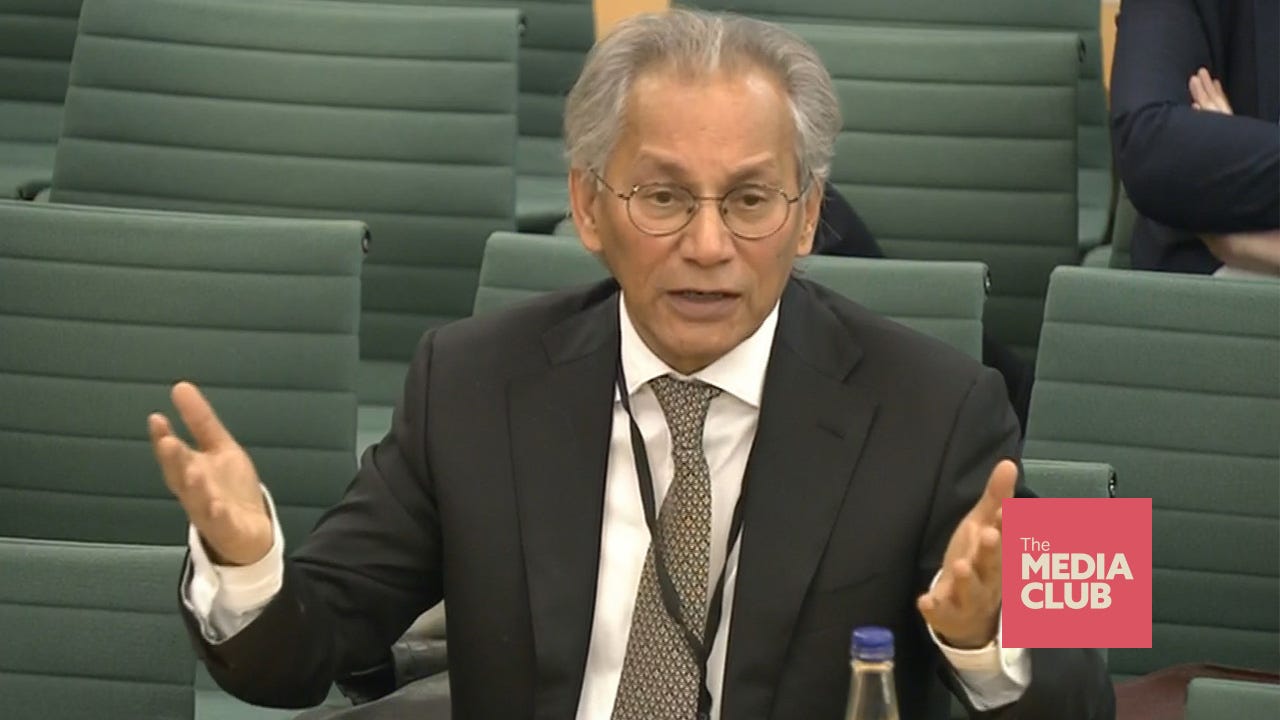
We’ve had a week where the Telegraph sale took another bewildering turn with the Mail finally stumping up the cash, the BBC faced yet more uncomfortable questions from MPs whilst trying to defend the editing of the Reith Lecture, and artificial intelligence continued its relentless march through every corner of media from search engines to studio management. Plus Christmas advertising battles reached fever pitch as brands experimented with everything from four-minute rom-coms to bite-sized social clips, whilst public broadcasting on both sides of the Atlantic braced for existential political threats.
If you missed Friday’s The Media Club, I was joined by Private Eye’s Adam MacQueen to dissect the latest Telegraph sale twist and what it means for press plurality, plus Cara Kotschy from Residence Pictures explained why the UK’s studio building boom might not solve all our production problems. We also covered the BBC’s select committee grilling, the missing tax credits from the budget, and that lost Blackadder Christmas script that’s gone up for auction. Listen
The Media Show
Katie Razzall and Ros Atkins covered this week’s media earthquakes, with Dame Caroline Dinenage MP, Chair of the Culture Media and Sport Committee, former Financial Times editor Lionel Barber, and Max Goldbart from Deadline to unpack the BBC crisis in all its complexity. From Samir Shah’s increasingly precarious leadership position to the explosive resignation letter from Shumeet Banerji, they examined how deep the dysfunction runs at Broadcasting House. The conversation also tackled the editing of Rutger Bregman’s Reith Lecture to remove criticism of Donald Trump, raising fundamental questions about editorial independence. They rounded out the discussion with analysis of the Telegraph’s £500 million sale to the Daily Mail group—one of the biggest media consolidations in recent British history—and CNN’s Donie O’Sullivan joined to discuss his new documentary MisinfoNation: White Genocide.
Media Confidential
Alan Rusbridger and Janine Gibson analysed the BBC’s looming select committee appearance and speculating about potential solutions to the corporation’s leadership crisis. They also explored the implications of the Telegraph-Mail merger for Britain’s right-wing media landscape. Later in the week they featured Alan’s first-hand account of Monday’s select committee hearing, where he observed MPs failing to address the elephant in the room regarding BBC governance. With Lionel Barber back from his travels, they examined claims by historian Rutger Bregman that the BBC censored his annual lecture to remove negative mentions of Donald Trump, plus they tackled the OBR’s accidental budget leak and the ethics of reporting on government slip-ups.
Roger Bolton’s Beeb Watch
Roger Bolton’s main interview featured Dan Thomas, the Financial Times global media editor, for a wide-ranging discussion about the Sky-ITV merger talks and their massive implications for public service broadcasting. Thomas argued that this wouldn’t have been thinkable not long ago and could fundamentally reshape the entire broadcasting landscape, with huge ramifications for both the BBC and Channel 4. Bolton also podcast highlights from the Voice of the Listener and Viewer autumn conference, including a session on impartiality standards chaired by Ritula Shah with Professor Stephen Cushion, Stewart Purvis CBE, and Richard Ayre examining the recent BBC crisis and governance challenges. A separate conference panel featured Mark Damazer and Professor Stephen Barnett discussing what’s next for the BBC, explored everything from the politicisation of the BBC Board to proposals for genuinely independent appointments.
The Rest Is Entertainment
Richard Osman and Marina Hyde tackled the biggest entertainment comebacks in history across their weekly episodes. They examined Wicked 2’s box office magic in what’s been a difficult year for Hollywood blockbusters, asking whether it’s finally managed to break the curse on 2025’s disappointing figures. The duo analysed this year’s Christmas advertising war, from John Lewis to Waitrose, questioning who’s created the most memorable festive content and whether audiences actually care if ads are created using AI. They also pondered the biggest ever entertainment comebacks, charting resurrection stories from Hollywood’s golden age through to modern musical revivals, offering their typically irreverent take on which stars have managed the most impressive career turnarounds.
The Media Odyssey
Evan Shapiro and Marion Ranchet looked at a case study on the BBC Studios-YouTube partnership. They interviewed Pedro Pina, VP of YouTube in Europe, the Middle East, and Africa, plus Jasmine Dawson, SVP of Digital at BBC Studios, for an in-depth exploration of how traditional media and creator platforms are rewriting international entertainment rules. The conversation revealed how BBC Studios transformed brands like Bluey, BBC Earth, and Top Gear into multi-format ecosystems using YouTube as a fandom-building hub rather than just another distribution channel. Key insights included how YouTube acts as an incremental audience driver rather than cannibalising traditional viewing, why audience-first strategy now beats commissioner-first strategy, and how BBC Studios’ “Creators in Residence” programme gives them crucial competitive advantages in platform-native thinking.
The Radio Academy Podcast
Georgie Jameson celebrated the announcement of the 2025 class of The Aiir Radio Academy 30 Under 30, sharing the surprise phone calls that revealed the exciting news to this year’s winners. The episode featured reactions from successful candidates across the industry, from senior social media producers at Baron Media in Scotland to audio producers at Bespoke Media in Edinburgh, BBC reporters, and podcast creators who’ve garnered millions of views. Ricki Lee, CEO of Aiir and sponsor of this year’s 30 Under 30, also shared insights about his own journey into the industry, providing inspiration for the next generation of radio talent making their mark across traditional broadcasting, podcasting, and digital platforms.
Campaign Podcast
Campaign’s editorial team gathered to dissect this year’s Christmas advertising landscape, examining whether TV still reigns as the top channel for festive films in an era of multiplying formats and fragmenting audiences. The discussion covered Waitrose’s four-minute rom-com “The Perfect Gift” by Wonderhood Studios, Tesco’s multi-spot “That’s what makes it Christmas” campaign by BBH, and Disney’s holiday short by Adam&Eve/DDB. Creativity and culture editor Gurjit Degun and deputy creativity and culture editor Charlotte Rawlings joined editor Maisie McCabe to explore why brands like Tesco and M&S Fashion, Home and Beauty replaced traditional longer TV ads with series of shorter videos, whilst Waitrose bucked the trend with their extended romantic comedy approach. They examined the role of Christmas advertising in the broader channel mix alongside social media and questioned whether the evolving format signals a fundamental shift in festive marketing strategies.
The Media Leader Podcast
Jack Benjamin sat down with Josh Krichefski, the former GroupM EMEA and UK CEO who recently joined PMG as EMEA president, to explore why he left WPP after more than a decade for an independent challenger agency. Krichefski outlined PMG’s go-to-market strategy built around transparency, consultancy, and data—explaining how their clients see all media pricing in complete transparency, a stark contrast to traditional agency models. The conversation covered PMG’s recent investment spree and talent acquisition strategy as it builds a full-service offering to challenge both holding groups and other independents. Krichefski also reflected on his tenure as IPA president from 2023 to 2025, where he championed his People First agenda focusing on industry talent acquisition and retention, and shared his views on agency consolidation and why AI represents an opportunity rather than a threat.
TV Makers
John Comerford, Head of Naked West, lifted the lid on how iconic legacy shows like Grand Designs, Escape to the Country and Great British Railway Journeys stay relevant after decades on air. The conversation explored what it really takes to future-proof long-running television in a digital-first world, from keeping Kevin McCloud, Michael Portillo and the teams behind the cameras creatively energised to protecting the core of heritage brands whilst adapting to modern viewing habits. Comerford shared leadership lessons learned across an impressive career and explained how producers balance preserving what audiences love with the innovation needed to survive in an increasingly competitive landscape. Essential insights for anyone working in television production about maintaining creative momentum over multiple decades.
MediaLand
Tim Burrowes and Danielle Seade examined gambling advertising regulation in Australia, exploring the political and business implications of increased restrictions on where and how betting companies can market their products. They spoke to Quentin Beresford, author of “Hooked: Inside the murky world of Australia’s gambling industry,” to discuss his investigation into gambling’s impact on daily Australian life and the industry’s resistance to tighter controls. The hosts also celebrated this week’s Walkley Awards for journalistic excellence, questioning whether journalism awards remain relevant in today’s media landscape. They covered the latest consolidation developments, including the Telegraph sale’s new twist opening doors to fresh buyers, and Warner Bros Discovery’s valuation challenges as it seeks more cash than investors currently believe it’s worth.
Podnews Weekly Review
James Cridland and Sam Sethi tackled the crucial question of podcast measurement, explaining why download numbers alone don’t tell the full story of podcast success. They spoke to Dan Misener to explore loyalty metrics and how to diagnose whether problems stem from new listener acquisition or returning listener retention. The conversation moved beyond vanity metrics to examine people numbers, playback intent, and time spent as core indicators of genuine growth. They also discussed tactics for turning download spikes into steady, loyal audiences, whilst addressing the ongoing AI content explosion that continues to flood the podcasting ecosystem with low-quality episodes despite industry criticism.
On the Media
Brooke Gladstone and Micah Loewinger produced two episodes exploring different aspects of media and democracy. Their main episode featured Jesse Thorn from Bullseye discussing surviving 25 years in the podcasting industry, offering insights into building sustainable public media that serves citizens rather than treating audiences as customers. Thorn articulated Bill Moyers’ vision of what public media should accomplish and argued for the essential role of publicly funded broadcasting that operates outside pure market forces. Their second episode tackled X’s overseas bot problem and featured a documentary about librarians under siege, examining how information professionals are caught in America’s culture war crossfires.
Mixed Signals from Semafor Media
Ben Smith and Max Tani interviewed Paula Kerger, CEO of America’s public broadcaster PBS, for a conversation about public broadcasting’s existential moment. Kerger addressed the political onslaught from the Trump administration and Congress, explaining what losing federal support would mean for hundreds of local stations across America. She made a passionate case for children’s programming and sparred with Ben about broadcast television’s continued relevance in an era of proliferating media options. The discussion explored whether deeply divided societies can sustain public media, with Kerger defending the unique role of government-funded broadcasting in serving all Americans regardless of political affiliation.
Channels with Peter Kafka
Peter Kafka hosted Tony Haile for a far-reaching discussion about the future of digital media in an AI-dominated landscape. Haile, the former CEO of Chartbeat and founder of Scroll (which Twitter acquired then killed), explained why his new company Filament represents a pivot away from traditional media into media-adjacent territory. The conversation explored what happens to media businesses built for web traffic when audiences increasingly bypass websites entirely, consuming content through AI summaries and social feeds instead. Haile shared insights from years of working with media companies of all sizes, offering a sobering but essential perspective on how AI is fundamentally reshaping the relationship between publishers, platforms, and audiences. Despite the challenging outlook, he identified glimmers of hope for media companies willing to radically rethink their approach.
Power Lines with Oliver Darcy and Jon Passantino
Oliver and Jon looked at Bari Weiss’s proposal to “redraw the lines” of acceptable debate by platforming voices like Alan Dershowitz and Dana Loesch whilst sidelining “extremists” like Tucker Carlson and Hasan Piker. They examined the problematic nature of this “both-sides-ism” approach and how it often requires amplifying individuals willing to distort facts in the Trump era. The hosts also revealed explosive new documents from the Smartmatic lawsuit showing private communications from top Fox News figures who chose ratings over facts during the 2020 election period, driven by fear of losing ground to Newsmax and OAN. They covered the ongoing fallout for Vanity Fair’s Olivia Nuzzi scandal and Donald Trump’s bizarre personal intervention to push Paramount into producing Rush Hour 4, likely due to ties with controversial director Brett Ratner.
The Grill Room
Dylan Byers and Julia Alexander examined the blurred lines between journalists and influencers in today’s media landscape, exploring how artificial intelligence is transforming tech giants like Apple and Google. They discussed the “Substackification” of legacy media and its implications for traditional publishing models. Dylan also hosted Brian Morrissey and Troy Young from People vs Algorithms to dig deeper into the media culture war between “information entrepreneurs” like Olivia Nuzzi and Michael Wolff versus old-school journalists such as Kara Swisher. The conversation explored the rise of performative reporting, the increasingly theatrical nature of modern journalism, and whether traditional media organisations can adapt quickly enough to compete in the new attention economy where content creation and journalism continue to merge.
The Town with Matthew Belloni
Matt Belloni sat down with legendary director James Cameron for an extensive interview covering misconceptions about Avatar franchise filmmaking, his preference for motion capture technology over traditional methods, and the true costs of CGI production. Cameron addressed whether he agrees with his reputation as a “difficult” director, discussed how the Avatar films landed at Fox/Disney, and shared his thoughts on AI’s growing threat to Hollywood creativity. The conversation also explored his relationship with Elon Musk, his deep-sea exploration work, and how pre-social media controversies around films like The Last Jedi might be handled differently in today’s environment. Cameron provided rare insights into his creative process and the business realities of making some of cinema’s most ambitious and expensive productions.
The Business
Kim Masters interviewed writer-director Rian Johnson and producer Ram Bergman about their latest Knives Out instalment, Wake Up Dead Man. Johnson opened up about relying on his producer when panic strikes during the writing process and explained why, oddly enough, he never hit that creative wall while making The Last Jedi. Bergman detailed why he and Johnson prefer to bankroll early development themselves rather than endure studio input during the creative process. They explored the Netflix collaboration in detail—how it provides a global megaphone for the Benoit Blanc mysteries whilst offering limited theatrical runs. Masters and Matt Belloni also tackled the baffling news that Paramount will distribute Rush Hour 4 with the previously cancelled Brett Ratner back in the director’s chair, examining reporting that suggests Donald Trump personally pushed for the franchise revival.
The Ankler Podcast
Elaine Low, Sean McNulty, and Natalie Jarvey examined how Wicked: For Good’s spectacular $150 million North American opening weekend demonstrated the power of female audiences—who made up 70% of ticket buyers—whilst highlighting how women have been largely underserved at the box office throughout 2025. They contrasted this success with the struggles of male-driven films featuring supposed movie stars like Glen Powell in The Running Man and Jeremy Allen White in Springsteen: Deliver Me From Nowhere. Prestige Junkie’s Katey Rich joined to lay out the key storylines as the Oscar race heats up, sharing insights from voters who still haven’t seen all the contenders and explaining why Warner Bros is sitting pretty with best picture frontrunners One Battle After Another and Sinners.
Spot any media podcasts we’ve missed? Reply and let us know! And if you haven’t already, subscribe to The Media Club on your favourite podcast app or catch us on YouTube. Got this forwarded to you? Then subscribe…